
5 Steps to Getting Your Goals Accomplished
I’ve been in the business world for … well … let’s just say a long time. One of the things that I have consistently seen over the years is that an organization’s strategy doesn’t ever seem to be fulfilled. There are several reasons for this.
In some companies, the strategy seems to change from month to month. If that is you, then that tells me that you really don’t have a strategy; what you have is a shotgun and you’re trying to hit anything that moves. You will never succeed with that plan. You might get lucky once in a while, but it will never be sustainable.
For others, they have what appears to be a solid plan, but it seems that they always come up short or even sometimes regress. If this is the boat you’re in, this article is for you!
Here are the steps that I have seen used effectively in organization’s that do make significant progress towards their goals. By the way, this works for company goals as a whole as well as for each and every individual team. The only real difference is that the individual teams (and perhaps the divisions they are a part of) must break the larger goals down to what they have influence or control over. For example, if my team is building the house, I don’t have direct influence over the number of sales calls the sales team makes, but I do have control over the quality of the workmanship.
Now the steps:
Distill your strategic goals down to just 1 page. This ensures that everyone can remember them and understand them. You should have no fewer than 4 and no more than 6.
Prioritize those goals from most important to least important as you see it now. We’ll come back to this later.
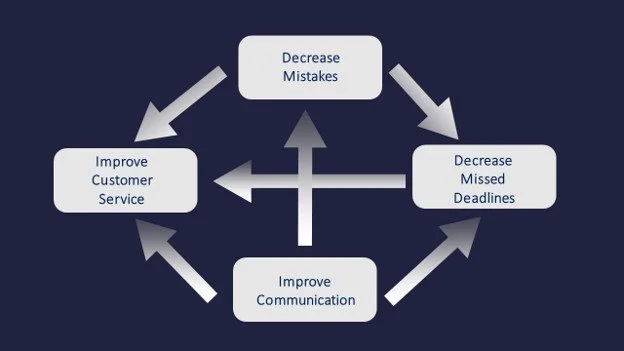
Place those goals on a sheet of paper in a flowchart like diagram (4 goals equals 4 boxes in a diamond shape, 5 goals, 5 boxes, etc., see the picture above).
Draw an arrow from each box to any other box(es) that it impacts. (I.e. Goal C has a direct impact on Goal A, so an arrow is drawn from Goal C to Goal A.) See the example above.
The arrows tell you which goal has the most impact and therefore is your new priority goal. Focus the vast majority of your resources on the new priority goal.
This process will help you identify what is REALLY your number 1 priority goal. More often than not, what you thought was your priority goal is not really the most important.
Here’s an example:
My four goals in my original priority order are: 1) Improve Customer Service, 2) Decrease Missed Deadlines, 3) Decrease Mistakes, 4) Improve Communication. Seems reasonable, right?
So, I draw arrows between boxes to indicate what drives another (see the picture above). I know that if I don’t miss as many deadlines, I will improve customer service. And If I don’t make as many mistakes, I’ll not miss so many deadlines. Also, if I’m a better communicator, I’ll improve customer service and decrease the mistakes that are made.
However, after I do this little exercise with the arrows, I see that the goal that impacts everything the most is the “Improve Communication” goal. THAT’S the one that I need to focus on. It is the “driving goal” to make all of the others successful. So even though “Improve Customer Service” seems like it should be the focus of everyone’s attention, in reality, “Improving Communication” will have a far greater impact on everything and Customer Service will be better by default! If I completely focused on the Customer Service side, I won’t be getting rid of the mistakes nor improving communication and so I’ll actually make Customer Service worse!
As I mentioned, this simple technique can be done at any level of the organization to significantly improve the chances of meeting your goals and therefore fulfilling your strategy.
As you work with this concept, I think you’ll find it to be a simple, yet very valuable tool in helping your team or your company to achieve more than they typically achieve. (Many thanks to Marcia Steele who brought this method to my attention.)