
Leadership Lessons From A Hike In The Mountains
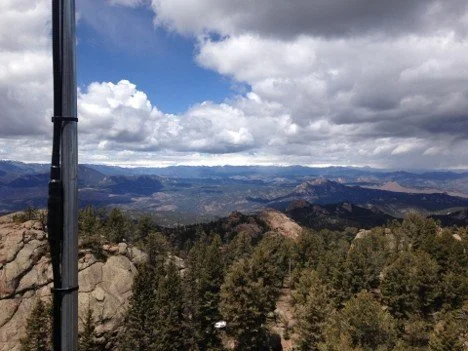
This past weekend, my family & I went for a short hike to a National Forest Service Fire Lookout Tower. It was only about 1.5 miles uphill. The Forest Service had built a nice trail using the rocks and some railroad ties to create steps in the steep spots. A harder hike than I anticipated, but still very nice and fun. We had to stop several times to catch our breath, but it felt good to get out in the Mountains again. And the view was spectacular from the tower! We could see at least 100 miles in every direction. It was amazing!
Then we headed back down the mountain. For those of you who hike in the mountains, you know that going down can actually be more dangerous than going up a hill. Going up, the biggest danger is a heart attack. Going down, a stumble can send you sprawling and damage multiple limbs. Your knees and ankles take a beating from the constant pounding from longer steps than normal. You can easily lose your footing and take a fall backwards, wrenching your back.
Here’s what I noticed on this particular hike: when approaching one of the railroad tie steps, I almost always ended up stepping down with my left foot, therefore bending my right knee to accommodate the step. As I started paying more attention to this phenomena, I realized that I must be subconsciously adjusting my stride so that I hit the steps in that way. There is no way that the Forest Service set this up to force that to happen; those kinds of things are just too random to plan in advance.
This got me to thinking about some other things on that hike down (and remember, only professionals should think like this when hiking downhill!); that is, how much we, as leaders, react subconsciously to so many things. That has the possibility of being a really good thing when our skill level is high and our teams are engaged with our vision.
But even then, there is danger in doing things from the subconscious level.
The main reason I noticed I was doing that step thing with my left leg was that I was feeling a little pain in my right knee. It was then that I realized I was ALWAYS bending my right knee and stepping with my left leg. Some of those steps were quite tall which means my knee was bending quite sharply.
So I consciously tried to do more bending of the left knee and taking the steps with my right leg. It was actually harder to do than I thought it should be, which just solidified in my mind how I must subconsciously WANT to step the other way. It was a habit that I’m sure I've built up over many years, not even knowing I was doing it nor intentionally building that “skill.” But changing to do something different was really hard.
In leadership, this is so true as well. As we get comfortable in our roles, we sometimes learn a skill unintentionally; that is, we simply start doing something that seems to work and it becomes ingrained in us. We also may learn something intentionally that we put into practice. Even though these may be “good” skills, they may end up wearing out over time, just as I’m sure my knee is beginning to wear out.
We normally won’t even think about changing our leadership approach unless we start to feel some pain in our actions. Maybe some key people begin to leave. Maybe some customers don’t seem to be as happy with us. Maybe productivity just seems to be lagging behind what it used to be.
These “little” pains will become big pains shortly if something isn't done to correct them. But just like me trying to step with the other leg, this can be really hard to do. A habit is a habit for a reason. It’s been said that to break a habit (or start a new one), you need to do a new thing for 21 straight days. Only then will it become natural to you. And that is the key; it must become natural.
So it’s always a good idea to first; determine where there might be some pain that your leadership is causing. We all want to be perfect, but unfortunately, none of us are. I can guarantee that there is something about your leadership style that is rubbing at least some people the wrong way. Figure out what that is and try to develop a new skill to overcome it.
Secondly, even if you don't think there is any pain now, just for the purpose of keeping you, your team and your organization “light footed,” learn new skills that can complement, supplement or just plain eliminate old skills that have run their course. Your team will appreciate you more and you’ll have more fun!
Don’t wait until someone decides they need a knee replacement...and you're the knee!